

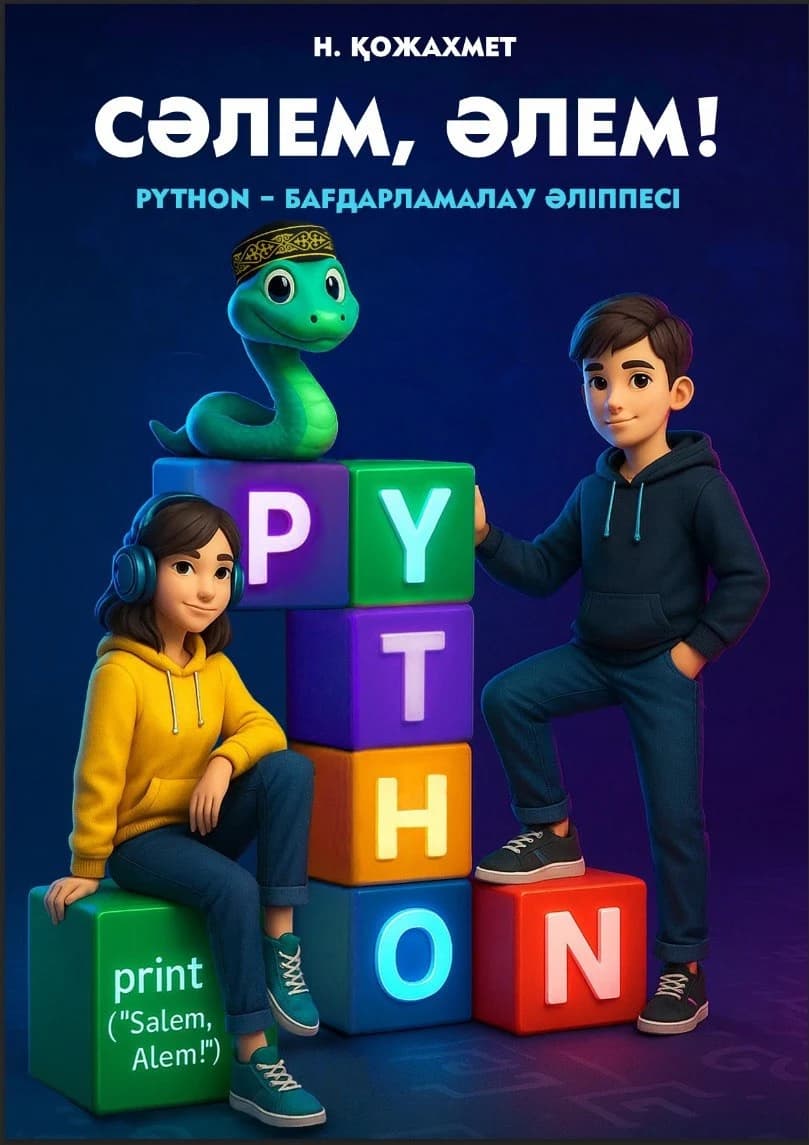
Сәлем, әлем!
Python — бағдарламалау әліппесі
Author: Қожахмет Нұрәділ
Three problems named by the author
Nuradil Kozhakhmet explains the purpose in the foreword. These are not promotional claims but three tasks he sets for the publication.
- 01
Few IT materials exist in Kazakh
The author notes that books in Kazakh about this relatively new field are still scarce.
- 02
The city and rural access gap
Students in rural schools receive especially little information about IT. The book is meant to offer a starting point regardless of where they study.
- 03
The myth of special talent
The book challenges the idea that only gifted people can program. Its emphasis is on practice, patience, and steady work.
“You do not need exceptional talent to become an IT specialist.”
First of all, school students
The book addresses students in Kazakhstan who are interested in IT but do not yet know where to begin.
- 01
Middle and high school students
The text does not assume university-level preparation. Examples progress from simple to more complex.
- 02
Readers opening Python for the first time
The opening chapters explain what a program is, how to install the environment, and how to run a first line of code.
- 03
Independent first study
The contents form a route through language basics, data structures, files, modules, classes, and one substantial project.
This is neither a reference manual nor a competitive programming problem book. It offers a first introduction to Python and works through one final project.
What the book actually covers
print("Сәлем, әлем!")- pp. 7–13Foreword, the author's story, and why programming is worth learning
- pp. 14–20Installing Python and writing a first program
- pp. 21–39Variables, data types, operators, conditions, functions, and loops
- pp. 41–57Lists, dictionaries, tuples, sets, and deque
- pp. 59–78Files, modules, classes, inheritance, and polymorphism
- pp. 79–111A Snake game in Pygame, from classes to the complete code
- pp. 112–115Conclusion and next steps in programming